

Factories Started Hiring Again. Filling the Jobs Is the Harder Half: This Month in Manufacturing
- Eddie Bearnot
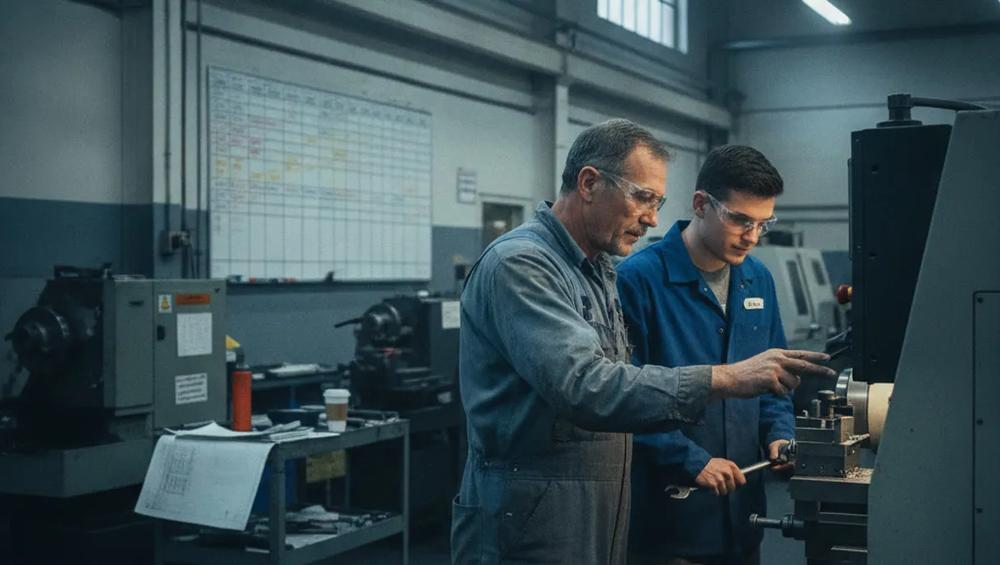
American factories spent 18 months shedding headcount. In August they stopped. The Philadelphia Fed's employment index jumped 18 points to 27.9, its highest reading since April 2022, and a third of surveyed firms reported adding people. The share reporting no change fell to 62 percent, the lowest in two years. Something turned.
Then look at the other side of the ledger. Job openings in manufacturing ended July 17 percent above the same point last year while hires stayed flat, the widest gap between posting a role and filling one all year. Demand for labor is running well ahead of the supply of labor. The plants winning this cycle are not the ones with the most requisitions open. They are the ones getting more out of the people already on the floor.
If you run a manufacturing operation in the $10M to $200M range, August handed you a good problem and an expensive one in the same month. Orders are there. Optimism is at a 40-year high. Input prices are cooling. And the constraint has moved from the order book to the schedule board, where every unfilled role turns into overtime, a missed ship date, or a job you quote high enough to lose.
In this issue
- Philly Fed employment index hits 27.9, highest since April 2022
- Manufacturing job openings run 17 percent above last year while hires stay flat
- Factory activity reaches a five-year high, six-month optimism the best since 1983
- Prices paid cool 13 points, capacity utilization sits at 76 percent
- 62 percent of small manufacturers call tariff costs a financial challenge
- Merchant cash advance applications climb as cash gets tight
- Robot orders broaden into food, pharma, and electronics
- SBA manufacturing loan fee waivers expire September 30
The Labor Turn Is Real, and Uneven
The Philadelphia Fed runs a monthly survey of manufacturers across eastern Pennsylvania, southern New Jersey, and Delaware, asking a simple question: up, down, or unchanged versus last month. The index subtracts the share reporting decreases from the share reporting increases, so a positive number means growth is spreading, not how much output rose. On this basis August was the broadest expansion in five years, with general activity at 47.4 and six-month expectations at their highest level since 1983. The employment component was the standout. Firms are not merely busy. They are staffing up for what comes next.
National data agrees, with a caveat. Manufacturing has added 29,000 jobs this year and employment still sits below its 2023 peak. July's gain of 5,000 was lopsided, with transportation equipment up nearly 12,000 while food manufacturing lost more than 6,000. Aggregate numbers hide the sorting happening underneath. Some plants are pulling in workers. Others are letting them go in the same month, in the same region, sometimes on the same street.
The tightest part of the picture is the gap between openings and hires. Applications rose 6 percent year over year, openings rose 17 percent, and actual hires went nowhere. Posting more roles has stopped producing more people. For a 150-person shop, the practical response is not a bigger recruiting budget. The better move is knowing which station is genuinely constrained before you write the job description, because half of what looks like a headcount shortage is a scheduling and visibility problem wearing a headcount costume.
Demand Holds While the Cost Side Finally Cools
Underneath the hiring story, the fundamentals improved. New orders eased 7 points to 30.1 and shipments slipped to 27.7, both still comfortably above their long-run averages. More useful for anyone buying steel or resin this quarter: the prices paid index fell 13 points to 40.9, its lowest since February, and 59 percent of firms reported no change in input costs at all, up from 46 percent. Input inflation is decelerating, not reversing, but a flat month is a planning window after two years without one.
Prices received fell too, down 10 points to 17.7, which is the part deserving attention. When your input costs cool faster than your selling prices, margin expands. When the reverse happens, margin quietly evaporates while revenue looks fine. Only 21 percent of firms raised their own prices in August. The rest are holding, and whether holding is a strength or a slow bleed depends entirely on whether you know your true cost per job.
Capacity utilization in manufacturing sat at 76.0 percent in July, still several points below its long-run average. Read alongside a five-year high in activity, the number says most plants have room to absorb more volume on equipment they already own. The ISM's July reading of 55.6 pointed the same direction, with production accelerating, backlogs rebuilding, and customer inventories thin. Expansion here looks less like new buildings and more like better use of the floor space already under roof.
The Tariff Bill Lands Hardest on the Smallest Balance Sheets
The Federal Reserve's Small Business Credit Survey found more than four in ten employer firms treating tariff-related costs as a financial challenge, rising to 62 percent in manufacturing. Sixty percent absorbed at least part of the cost rather than passing the increase through. The average small importer's bill ran roughly $306,000 higher than the prior year, with firms under 50 employees paying around $175,000 more. Large manufacturers route the same costs through hedged supply agreements and pricing power. A 90-person shop pays out of working capital.
The financing behavior confirms the squeeze. Applications for merchant cash advances, where a lender fronts capital against future sales at a steep effective rate, rose to 12 percent of credit-seeking firms from 9 percent. Businesses reach for expensive money when cheap money moves too slowly, and a bank underwriting cycle does not care about a container sitting at the port. The uncomfortable read: some of these firms are solvent and simply cannot prove solvency fast enough, because the numbers a lender wants live across four systems and a spreadsheet.
Where the Money Is Going
Automation demand is broadening away from its traditional home. North American companies ordered 8,940 robots worth $622 million in Q2, bringing the first half to 17,995 units and $1.166 billion, up 2 percent in units and 6.6 percent in value. The mix matters more than the total. Semiconductors and electronics led with 35 percent growth, followed by pharmaceuticals at 32 percent, automotive components at 24 percent, and food and consumer goods at 17 percent. Robotics has stopped being an automotive-OEM story with a seven-figure entry price and started showing up in the segments where a $40M manufacturer operates.
The software side is less encouraging. A reconciliation of five 2026 mid-market datasets found 94 percent of companies using generative AI and 2 percent running the technology at scale. Among manufacturers specifically, 55 percent named legacy system integration as their top barrier against a 41 percent mid-market average, and only 27 percent hold a data warehouse versus 60 percent of peers. The bottleneck is not the model. The bottleneck is four systems disagreeing about what a part number means. Fixing the record before pointing anything clever at the data is unglamorous work with a better return than most pilots.
One dated item worth a calendar entry: the SBA's fee waivers on manufacturing loans, 0 percent upfront on 7(a) loans up to $950,000 and 0 percent upfront plus no annual service fee on eligible 504 manufacturing loans, run only through September 30. If equipment financing is on your list for this fiscal year, the paperwork lead time is now the binding constraint, not the decision.
The Bottom Line
The order book stopped being the problem months ago. August's data says the constraint is now execution: enough people, enough visible capacity, and enough cost accuracy to price work without guessing. Hiring turned positive, input inflation cooled, and automation got cheaper to enter, all in the same month. Every one of those advantages rewards the operator who knows precisely where the bottleneck sits and precisely what a job costs.
The manufacturers who struggle through the next two quarters will not be the ones with weak demand. They will be the ones who cannot see their own floor clearly enough to act on the demand they already have.
In case you missed it
- Tariff Refunds Are Live While Wholesale Margins Slip to 3.8%: This Month in Wholesale Distribution
- Machinery Orders Run 32% Ahead of 2025, but Shipments Cannot Keep Up: This Month in Industrial Equipment
- The Squeezed Middle: What Is Hitting Small and Mid-Sized Food and Beverage Makers Right Now
- Distribution Margins Under Pressure: What Wholesale Leaders Need to Watch
If you are running a mid-sized plant and want to see your real capacity, labor load, and cost per job in one place, take the ERP assessment or book a conversation with Third Wave. We help manufacturers turn visibility into decisions.