

Memory Prices Nearly Doubled in a Quarter and Lead Times Passed 30 Weeks: This Month in High-Tech and Electronics
- Eddie Bearnot
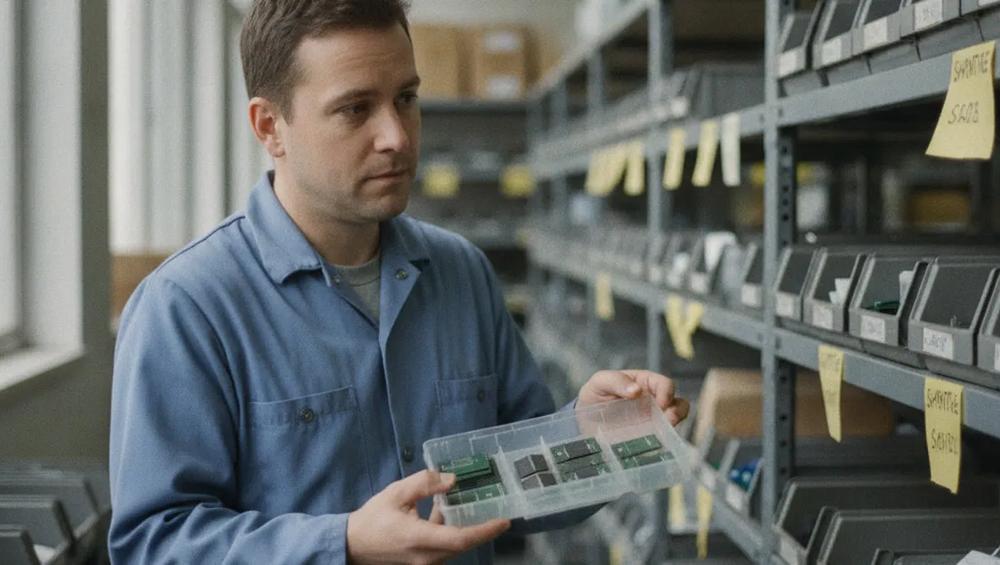
The most expensive line on your bill of materials this month was not labor, and not freight. Memory. Conventional DRAM contract prices rose roughly 90 to 95 percent quarter over quarter in Q1 2026, the steepest quarterly move the industry has recorded, and analysts projected another 58 to 63 percent on top of the number in Q2. NAND ran even hotter. A part you used to buy on a phone call now sets your delivery schedule.
If you build electronics for a living in the $10M to $200M range, you want the same three things you wanted in January: predictable input costs, parts arriving when the line needs them, and a quote you send to a customer with confidence for more than two weeks. Every story below makes one of those three harder. The demand side of the market is strong, which is the confusing part. Orders are ahead of shipments across North America. The constraint has moved from the order book to the supply of parts and the accuracy of your own cost data. Our manufacturing practice sees the same pattern in every shop of this size: the operators who hold margin are the ones who know their true landed cost per board before the quote goes out, not after the invoice lands.
In this issue
- DRAM and NAND contract prices post record quarterly increases, with lead times past 30 weeks
- Smaller buyers without direct supplier relationships face spot pricing up to 700 percent year over year
- Section 232 chip tariffs stay narrow for now, with a 100 percent threat still on the table
- Washington adds a 15 percent tariff and minimum import prices on polysilicon and wafers
- North American EMS shipments rise 6.7 percent with a 1.33 book-to-bill, PCB bookings up 31.5 percent
- Global chip sales hit $403.3 billion in Q2, and almost none of the capacity is aimed at you
- Domestic electronics manufacturing employment falls to 368,400, below the 2023 peak
- Component industry group warns off broker channels as counterfeit exposure climbs
- PCB and EMS deal flow restarts after a slow first quarter
The Headline: Memory Stopped Being a Commodity
Start with the number, because everything downstream bends around the number. DRAM contract prices rose approximately 90 to 95 percent quarter over quarter in Q1 2026, and TrendForce projected a further 58 to 63 percent in Q2. NAND flash rose 55 to 60 percent in Q1 with a projected 70 to 75 percent in Q2, a pace outrunning DRAM for the first time in this cycle. The cause is structural rather than cyclical. Suppliers keep reallocating wafer capacity toward high-bandwidth memory for AI accelerators, where margins are better, and HBM carries a roughly three-to-one wafer penalty against standard DRAM. Every wafer sent to an AI customer removes three wafers of the memory your product uses. New capacity is not expected to relieve the market until late 2027 at the earliest, and TechInsights expects elevated pricing through the rest of the decade. The practical consequence for a smaller builder: memory is a forecasted, contracted purchase now, not a spot buy. HIPER Global's mid-year supply update is the clearest summary of where the market sits.
Lead times tell the same story from the other end. Industrial-grade module lead times have stretched from single-digit weeks to well over 30 in some cases, and contract prices for 12GB LPDDR5X modules jumped 89 percent quarter over quarter in Q2, from $77.10 to $145.90, with advanced memory lead times running 40 to 58 weeks. Under allocation, the date you place the order sets the date you ship the product. Anyone still running just-in-time on memory is running a scheduling model the market no longer supports. Utmel's LPDDR5 procurement analysis walks through the numbers.
Then there is the part nobody at the top of the market feels. Smaller OEMs without direct manufacturer relationships have been pushed onto spot pricing, which in some cases surged as much as 700 percent year over year as of July. Large buyers hold contracts. Small buyers hold purchase orders and hope. The gap between the two is now the single biggest driver of margin variance between two shops building similar products, which makes supplier qualification and forward contracting a survival skill rather than a procurement nicety.
Trade Policy Is Now a Cost Line, Not a Headline
The tariff picture is calmer than the rhetoric, and planning around the rhetoric is the mistake. The operative mechanism is a Section 232 proclamation in effect since mid-January applying a 25 percent duty to a narrow band of advanced computing chips, with carve-outs for data centers, repairs, research, startups, consumer electronics, and public-sector use. Most mid-market builders sit inside a carve-out today. The exposure is forward-looking: Commerce Secretary Howard Lutnick has repeatedly floated tariffs as high as 100 percent on Korean and Taiwanese chipmakers who decline to expand domestic capacity, while Taiwan has already settled at 15 percent on most goods with duty-free allowances tied to a $250 billion investment commitment. A separate round aimed at Chinese semiconductor and component imports has been announced with rates unspecified and no effect until June 2027. EMSNow's read on the current state is worth the ten minutes.
The one action taken this month landed upstream. On August 6 the administration imposed a 15 percent Section 232 tariff on polysilicon and derivative products, paired with minimum import prices importers must certify to Customs at entry. The finding behind the action is sobering on its own: US polysilicon production fell from about half of global share in 2005 to under 2 percent in 2024, and wafer fabrication from 37 percent in 1990 to 10 percent in 2024. If your product carries solar cells, power components, or wafers of any kind, the cost floor moved on you with three weeks of notice. Fixed-term contracts signed before August 6 are exempt, which rewards the shops with paperwork in order and penalizes the ones buying ad hoc. Wiley's alert covers the mechanics.
Demand Is Strong, Which Is Not the Same as Easy
North American demand is running ahead of supply, and the data is unambiguous. EMS shipments rose 6.7 percent year over year in June with a three-month book-to-bill ratio of 1.33. PCB shipments rose 12.0 percent year over year, bookings rose 31.5 percent, and the PCB book-to-bill has since been reported at 1.60. Book-to-bill measures new orders against product shipped, so any reading above 1.0 means the backlog is growing. A 1.60 reading means orders are arriving more than half again as fast as boards go out the door. Growth of this shape is a good problem and a real one. Backlog you cannot convert is working capital sitting on the floor, and customers eventually shop the delay. See the June EMS figures and the PCB data for the detail.
Global numbers look euphoric and mean something different. Semiconductor sales reached $403.3 billion in Q2 2026, up 35.1 percent sequentially, with June alone at $134.5 billion, up 123.6 percent year over year, per the Semiconductor Industry Association. Read the figure carefully before taking comfort. The growth is concentrated in AI accelerators and the memory feeding them. For a builder of industrial controls or medical devices, the boom is the reason your parts are scarce, not evidence your end market is expanding. Domestic conditions are steadier: the July ISM Manufacturing PMI came in at 55.6 percent, a four-year high, with Computer and Electronic Products among the industries reporting both higher employment and higher prices.
Labor remains the quiet constraint. Employment in US semiconductor and electronic component manufacturing has fallen from roughly 401,000 in 2023 to 368,400 as of March 2026. Reshoring announcements keep arriving. The workforce to staff them has been shrinking for three years. For a mid-market shop, the takeaway is unglamorous: the throughput you add this year comes from process and automation, not from a hiring plan.
Where the Risk and the Money Are Moving
Scarcity always produces a shadow market, and this one is growing. On June 10 the Electronic Components Industry Association issued a position paper urging manufacturers and buyers to source exclusively through manufacturer-authorized channels, warning explicitly against gray market and broker purchases. The association's argument is sharp: inspection and electrical testing cannot establish a part's origin, and only authorized distribution provides documented chain of custody. The stakes justify the tone. Counterfeit electronics cost the industry more than $7.5 billion a year by SIA estimates, with up to 15 percent of replacement parts globally suspected fake, and one reseller association logged a 25 percent rise in counterfeit parts in a single year. When a memory part is 30 weeks out, the broker offering stock next week is the most dangerous email in your inbox. ECIA's guidance deserves a place in your supplier qualification policy.
Capital is moving too. PCB and EMS deal flow in North America stalled through the first quarter under oil price and geopolitical uncertainty, then reopened hard in May, June, and July. East West Manufacturing acquired Vexos, private equity took Green Circuits, Kimball Electronics bought Helvoet Polymer Technologies, and CircuitHub raised $28 million. The drivers are retiring owners, private equity with capital to deploy, and buyers chasing defense and high-speed data exposure. For an owner in this range, the trend cuts both ways: real exit optionality if your operation shows clean numbers and documented process, and better-funded competition for the same customers if you stay put. GP Ventures tracks the deal list.
The one genuinely encouraging story is on the plant floor. Machine vision inspection historically required vision engineers, heavy programming, and long commissioning, which kept adoption inside large manufacturers. Newer autonomous systems are collapsing the setup cost, and electronics manufacturers report meaningfully higher inspection accuracy after deployment. With labor tight and scrap expensive at current component prices, catching a defect before a $150 memory module goes on the board changes the math on quality spend. ARC Advisory Group explains where the barrier finally dropped.
The Bottom Line
Two forces are pulling in opposite directions, and a mid-market electronics builder sits between them. Orders are running well ahead of shipments. Component costs are moving faster than any quote cycle designed to absorb them. The firms who lose money in this market will not lose because demand disappeared. They will lose because they quoted a 12-week build at January component pricing and delivered in week 34. Scale is not the fix. Cost visibility is. Know your landed cost per part, your real lead time by supplier, and which contracts locked in a price before the last increase. The shops with the discipline will take share from the ones still finding out at month-end close.
In case you missed it
- Washington Is About to Define Ultra-Processed. Here Is What It Means for Smaller Food Makers: This Month in Food and Beverage
- Tariff Refunds Are Live While Wholesale Margins Slip to 3.8%: This Month in Wholesale Distribution
- SBA Doubles Loan Limits to $10M as Manufacturing Activity Hits a Five-Year High: This Month in Manufacturing
- Machinery Orders Run 32% Ahead of 2025, but Shipments Cannot Keep Up: The Month in Industrial Equipment
Where Third Wave fits
None of this needs a bigger team. All of this needs one place where component cost, supplier lead time, work in process, and quoted margin connect, so a pricing decision reflects today rather than last quarter. Helping mid-market manufacturers build the visibility is the work we do. If you are unsure how quickly your current systems would show a 60 percent jump in a key component cost, start with our free ERP assessment or book a consult. No pitch, only a clear read on where you stand.