

Job Shops Are Outbuying the Market While Orders Cool: This Month in Industrial Equipment and Machinery
- Third Wave StaffInsights from the Third Wave team
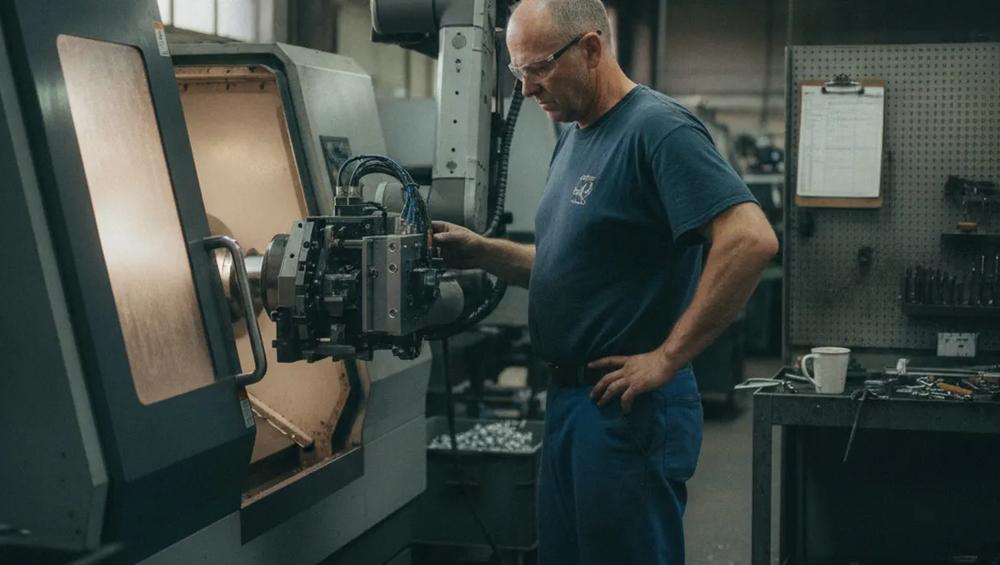
The most telling number of the month was not the record. It was the 1.3%. Metalworking machinery orders fell 8.0% from June to July, and orders coming from contract machine shops fell only 1.3%, with unit volumes rising over 2%. The shops with the least balance-sheet cushion and the shortest visibility into next quarter kept signing. Take it as the clearest available signal about where real capacity demand sits.
If you build or service equipment in the $10M to $200M range, you want two things from a month like this: confidence the order book holds, and a reason to commit capital before the cost of waiting exceeds the cost of buying. The news this month gives you the first and complicates the second. Third Wave works with mid-market manufacturers on exactly this question, and our free ERP assessment is a quick way to see whether your systems would survive the growth you are planning for.
In this issue
- Machinery orders hit $605.8M in July, down 8.0% from June, up 55.2% from July 2025
- First-half orders of $3.44B set the strongest half-year since data collection began in 1998
- Order value up 37.1% year to date while unit counts rose only 13.0%
- Contract machine shop orders nearly flat month over month as units grew
- Forging and stamping orders reach their highest level since December 2012
- North American robot orders hit 8,940 units and $622M in Q2, up 21.3% in value
- Section 232 tariffs on some mobile industrial equipment cut from 25% to 15% through 2027
- 100% bonus depreciation and a $2.56M Section 179 cap remain available this tax year
- 66% of manufacturers rate hiring welders and machinists as difficult or at crisis level
- Electrical equipment backlogs and lead times keep stretching project timelines
A Record Book and a Softer Month
New orders of metalworking machinery totaled $605.8 million in July, an 8.0% drop from June and a 55.2% jump over July 2025. The first half of 2026 produced $3.44 billion in orders, the strongest half-year since the U.S. Manufacturing Technology Orders program started tracking in 1998, and the seven-month total of $4.03 billion runs 37.1% ahead of last year. July also marked only the second time on record with five consecutive months above half a billion dollars. A single soft month inside a run like this is noise, not a turn.
The composition matters more than the total. Order value grew 37.1% while the number of units ordered rose 13.0%. Machines are not inflating at anything like this spread, so the gap is automation content: pallet pools, bar feeders, robotic tending, probing and in-process gauging bolted onto the same machine count. Buyers are not adding more spindles. They are buying spindles which run unattended. The pullback in July came mostly from makers of engines, turbines and power transmission equipment, a sector running more than 35% above its long-run average for two years on grid demand. Electrical equipment makers went the other way and posted the year's highest monthly orders. Closely related sectors are no longer moving together, which makes a diversified customer list more valuable than a strong one. Full USMTO figures are worth a look if you quote into any of these end markets.
Two other signals sit underneath. Forging and stamping orders reached their highest level since December 2012, which is the part of the supply chain nobody invests in during a soft cycle. And robot demand keeps broadening. North American companies ordered 8,940 robots worth $622 million in the second quarter, up 4.3% in units and 21.3% in value, bringing first-half orders to 17,995 units and $1.166 billion. Automotive OEM orders fell 25%. Semiconductors and electronics rose 35%, life sciences 32%, automotive components 24%, food and consumer goods 17%. The A3 data says automation stopped being a car-plant story. For a smaller builder, the practical read is simple: the integration work and the aftermarket attached to these cells is now spread across a dozen industries rather than concentrated in one.
The Window on Cost and Capital
Tariff arithmetic improved for part of the sector. A revised Section 232 proclamation effective June 8 cut duties from 25% to 15% on certain agricultural, construction and mobile industrial equipment from qualifying trade partners, and dropped the U.S. steel content threshold for preferential treatment from 95% to 85%. The relief runs through the end of 2027, at which point the original structure snaps back. The change is a timing benefit, not a reprieve. Steel and aluminum remain at 50% under the base tariff, so the underlying input math is unchanged for anyone outside the carved-out categories. If your product qualifies, the next eighteen months are the cheapest landed cost you will see, and the content threshold shift is worth a serious look at your bill of materials before you assume you miss it.
On the buy side, the tax code is doing the persuading. Bonus depreciation stands at 100% for qualified equipment placed in service, with a Section 179 cap of $2.56 million and phase-out beginning above $4.09 million in purchases. A $600,000 machining center bought and running this year deducts in full this year. Put together with a record order book and stretched delivery times, the calculus favors committing early and taking the slot. The cost of a 2027 install date is not only the price increase. Knowing what your own backlog and margin by job look like before you sign is the harder part, and it is where most shops find their reporting is slower than their decisions.
What Money Will Not Fix
Two constraints are tightening regardless of capital. The second annual USA Reshoring Survey polled 249 manufacturers and found 63% of OEMs planning U.S. capital investment through 2027, with contract manufacturers quoting twice as many reshoring projects as last year. In the same survey, 66% rated hiring welders and machinists as difficult or at crisis level, and 60% said the same about maintenance and repair technicians. Demand is arriving faster than the people to serve it. This is the real driver behind the automation content in the order figures, and it is also why unattended runtime and machine monitoring now carry a payback argument unrelated to headcount reduction.
The second constraint is the grid. Electrical equipment backlogs have roughly doubled year over year in categories like distribution transformers, and switchgear and generator lead times for industrial and data center projects now run 12 to 18 months. A machine bought in September with a nine-month build sitting behind a fourteen-month service upgrade is not capacity. It is inventory. Order the power ahead of the metal.
Broader demand, meanwhile, is cooling from a high base. August ISM manufacturing came in at 54.6%, the eighth straight month of expansion, with new orders down 3.0 points to 53.7 and backlogs down 3.2 points to 51.8. Both still signal growth. The prices index held at 71.1 and supplier deliveries slowed to 59.3, which is the uncomfortable combination: softer order intake alongside rising input costs and slower supply. Quoting on last year's cost assumptions is how shops win work at a loss in a month like this.
The Bottom Line
IMTS opens in Chicago this week with more than 2,000 exhibitors and 1.2 million square feet of floor, and the buyers walking it hold the strongest order book in the program's history and a July down 8%. Both facts are true. The right response is not a view on the cycle. It is to make the decision small enough to reverse: buy the automation attachment rather than the extra machine, secure the electrical lead time before the delivery date, use the depreciation while it is written into law, and get your backlog and job-level margin visible enough to know which quote you should decline. Contract shops with the least protection kept buying in July. They tend to be right about capacity.
In case you missed it
- A Third of This Year's Food Recalls Were Label Problems: This Month in Food and Beverage
- Factories Started Hiring Again. Filling the Jobs Is the Harder Half: This Month in Manufacturing
- Tariff Refunds Are Live While Wholesale Margins Slip to 3.8%: This Month in Wholesale Distribution
- Memory Prices Nearly Doubled in a Quarter and Lead Times Passed 30 Weeks: This Month in High-Tech and Electronics
Where to start
Record orders reward the shops who know their true capacity and their real margin per job. If yours live in spreadsheets and tribal knowledge, growth gets expensive quietly. Third Wave has spent 23 years helping mid-market manufacturers put this visibility in one place, usually on SAP Business One. Take the ERP assessment or book a conversation and we will tell you plainly whether a change is worth your time this year.