

Formulas and recipe BOMs
Formulas held by weight or volume with yield and scrap, scaled to the batch size, with by-products and intermediates on the same production order.

Chemical manufacturing ERP that keeps formulas, batches, lot traceability and compliance documents in the same system as purchasing, inventory and financials.
Why chemical makers call us
Most specialty chemical makers come to us at the same point: formulas live in spreadsheets, lot records live in a filing cabinet, and a customer's request for a certificate of analysis starts a hunt. Inventory is counted in drums on the floor and gallons in the system, and nobody is sure which is right.
SAP Business One for chemical manufacturing replaces that patchwork with one system for formulas and bills of materials, production orders, batch and lot control, quality, inventory, purchasing and financials, configured around how process manufacturers actually run.
Not sure where the gaps are yet? Start with a free ERP assessment.

Requirements
Eight areas where chemical ERP software earns its keep, and the ones we configure first.
Formulas held by weight or volume with yield and scrap, scaled to the batch size, with by-products and intermediates on the same production order.
Every raw material lot traced into every batch and out to every customer shipment, so a recall report runs in minutes rather than days.
Test results recorded per lot, release or quarantine before shipping, and the certificate of analysis printed from the system with the shipment.
Safety data sheets and hazard classifications tied to the item record, with versions kept, so labels and documents match what ships.
Actual against standard cost per batch, with yield variance and labor visible by product line instead of buried in a month-end spreadsheet.
Hazard classes and UN numbers on the item, carrier labels from ShipEasy, and shipping documents that match the safety data sheet.
Buy in kilograms, make in gallons, sell in drums, totes and pails, with the conversions held in the item master rather than in someone's head.
Purchase recommendations from demand and lead times, first-expired-first-out picking, and an expiry date on every lot.
Process and batch manufacturing
SAP Business One runs batch processes through its production orders. A formula is a bill of materials in weight or volume, a batch is a production order scaled to the vessel, and components are issued and finished product received against it with batch and lot numbers assigned at receipt, expiry dates, and a quality hold until release. By-products and intermediates are received on the same order.
That covers most blending, mixing and filling operations we see. Where a formulator needs more, such as potency adjustment, multi-level yield modelling or regulatory document generation, we add a process manufacturing add-on and name it in the fit summary before anything is quoted.
SAP Business One for process manufacturing works alongside discrete production in the same company, so a plant that blends a product and then kits it with hardware does not need two systems.
In the video, the Santec Chemicals team describes what changed when production and project data moved into SAP Business One.
The Third Wave build
SAP Business One already covers formulas, production, inventory, purchasing, sales and financials. What makes it a chemical ERP is the configuration and the add-ons around it. A typical Third Wave chemicals build includes:
Every build starts with your formulas, your item master and your regulatory documents, not a template.

Sub-sectors
Different chemistries, the same operating problems: formulas that drift, lots that have to trace, and documents that have to match what ships.
Santec Chemicals makes commercial cleaning products and systems for food service, hospitality and healthcare, and runs manufacturing and project management on SAP Business One.
Multi-stage formulas, color and viscosity specs per batch, and customers who want the certificate of analysis with every shipment.
Base stocks and additive packages blended to spec, bulk and packaged inventory in the same system, and weight-to-volume conversions on every transaction.
Formulas with potency and allergen declarations, small batches with frequent changeovers, and labeling that has to match the regulatory file.
Customer-owned formulas and materials, batch records kept per customer, and job costing that shows what each run actually earned.
Bulk inbound, repackaged outbound, lot numbers carried through every split, and landed cost on imported material.
Client results
A cleaning-products manufacturer that unified QuickBooks, inventory and shipping on SAP Business One, then came back for data analysis, training and a leaner production setup.
 Success Story
Santec Chemicals
The complexity of Santec Chemicals’ manufacturing and project management systems challenged prior contractors lacking comprehensive business process experience.
 Case Study
Santec Chemical
Santec is a provider of commercial cleaning products and systems, specializing in the food service, hospitality, and healthcare industries.
Client reviews

They provided automated programs that have greatly reduced manual labor time, reduced errors, and simply provided data we otherwise would not have had access to easily.
They are responsive, consistent, and thorough; they are able and willing to examine the underlying business process to best understand which technological options will address the true need.
Knowledgeable resources covering all aspects of SAP B1. They provide some very helpful add-ons and auxiliary software that helps dealing with SAP's shortfalls.
How to choose
Most chemical ERP comparisons rank vendors. The better test is whether the system can hold your formulas, trace your lots and produce your documents without a spreadsheet beside it. Five questions settle it.
If it lives in a spreadsheet and the ERP holds a simplified bill of materials, batch cost and inventory will never agree.
Ask for a mock recall in the demo: pick a raw material lot and find every customer who received product made from it.
From item and lot data in the system, or from a shared drive someone maintains by hand. Only one of those survives an audit.
Licenses, implementation, add-ons and hosting. Our SAP Business One pricing guide lays out the ranges and what moves them.
Migrating formulas, lots on hand and open orders moves the date more than plant size. Our implementation timeline guide covers the phases, and Santec Chemicals above shows the kind of plant we have taken live.
 Third Wave
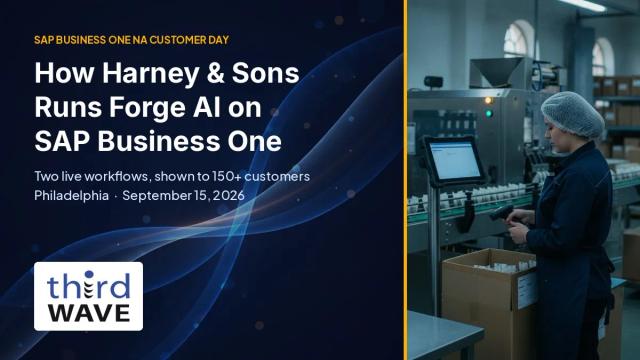
Harney & Sons Fine Teas closed SAP Business One Customer Day with Third Wave, showing 150+ customers two Forge workflows in production. We walk through shop floor data capture, AI sales order processing, the safeguards behind both, and Forge in the web client.
 Digital Transformation
Spreadsheets feel like the perfect operational tool when you're growing. Until they aren't. The hidden costs of spreadsheet-driven manufacturing and distribution: inventory uncertainty, reporting lag, tribal-knowledge dependency, and how integrated ERP systems help mid-market companies regain visibility, efficiency, and control.
 Supply Chain
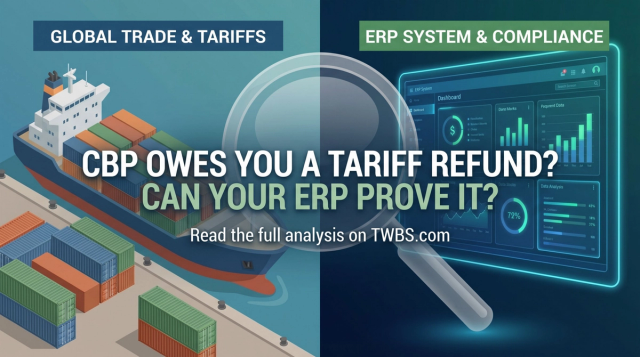
CBP just opened a $166 billion refund portal. The filing is simple — the data isn't. Here's who qualifies in Phase 1, exactly how to file, and why the companies that get paid first are the ones with the cleanest ERP data.