

Lot traceability and mock recalls
Every ingredient lot traced into every batch and out to every customer, so a mock recall or an FSMA 204 traceability request runs in minutes rather than a day.

Food manufacturing software that keeps recipes, lot traceability, expiry dates and allergen data in the same system as purchasing, inventory and financials.
Why producers call us
Most food and beverage makers come to us at the same point: recipes live in a binder or a spreadsheet, lot numbers are written on a clipboard, and a retailer's traceability request or a mock recall takes a day of digging. Inventory is counted in cases on the floor and pounds in the system, and nobody is sure which is right.
SAP Business One for food and beverage replaces that patchwork with one system for recipes and bills of materials, production orders, lot and expiry control, quality records, inventory, purchasing and financials, configured around how producers actually run: recipes with yield, batches scaled to the kettle or the line, lot genealogy from supplier delivery to shipped case, and first-expired-first-out picking.
Not sure where the gaps are yet? Start with a free ERP assessment.

Requirements
Eight areas where food and beverage ERP software earns its keep, and the ones we configure first.
Every ingredient lot traced into every batch and out to every customer, so a mock recall or an FSMA 204 traceability request runs in minutes rather than a day.
Recipes held by weight or volume with expected yield and scrap, scaled to the batch, with by-products and rework on the same production order.
An expiry date on every lot, first-expired-first-out picking, and alerts before stock ages out, so short-dated product ships first instead of being written off.
Allergen declarations and label data held on the item record so labels print from one source. A third of this year's food recalls were label problems.
Buy by the pound, make by the batch, sell by the case, with variable-weight items handled through configuration or an add-on named before quoting.
Receiving inspections, in-process checks and release or hold decisions recorded against the lot, with the records an auditor expects to see.
Production and inventory at co-packers and third-party warehouses visible in the same system, with their receipts and shipments posting against your lots.
Orders in, ship notices and invoices out through EDI, with margin reported by SKU, customer and channel.
Beverage
Beverage producers add their own wrinkles: liquid in tanks measured in gallons while finished goods are counted in cases, bottles and kegs; returnable kegs and deposits that have to be tracked by customer; and volume reporting by package type for the filings you have to make.
SAP Business One holds the tank-to-case conversions in the item master, tracks returnable containers as their own items against each customer, and reports volume by package type from the same transactions that run the business.

The Third Wave build
SAP Business One already covers recipes, production, inventory, purchasing, sales and financials. What makes it a food and beverage ERP is the configuration and the add-ons around it. A typical Third Wave build for a producer includes:
Every build starts with your recipes, your item master and your lot and label data, not a template.

Growing producers
Food manufacturing software for a small business has to do the same traceability a large plant does, without a large plant's IT department. SAP Business One is licensed per user and configured to the lines you run today, with the rest switched on as you grow.
Most of the producers we work with came from QuickBooks or a bookkeeping package plus spreadsheets. The move is usually triggered by a retailer's traceability demand, a co-packer relationship, or a second facility, and the goal is the same each time: one set of numbers that production, sales and finance all trust.

Sub-sectors
Different products, the same operating problems: lots that have to trace, dates that have to be managed, and labels that have to match what is in the package.
Harney & Sons blends more than 300 teas across sachet, filling, blending and bagging lines, with production data captured at the line into SAP Business One.
High SKU counts, seasonal and promotional packs, allergen declarations by recipe, and retailer EDI with chargebacks.
Tank volumes, package conversions, returnable kegs and deposits, and volume reporting by package type.
Lot and expiry tracking across warehouses, first-expired-first-out picking, catch weight, and recall reports across every customer shipped.
Customer-owned recipes and materials, batch records kept per customer, and job costing that shows what each run actually earned.
GMP batch records, potency and expiry on every lot, and the documentation a regulated line has to produce on request.
Client results
Harney & Sons Fine Teas is a family-owned tea blender in Millerton, New York, blending tea since 1983 with more than 300 teas and herbal blends. The company has run SAP Business One with Third Wave since 2022 and went live on Forge AI in March 2026.
More than 20 paper production forms across sachets, filling, blending and bagging were replaced with validated capture at the line. Operators scan the item, batch and bin from the label, anything outside a department's tolerance waits for a supervisor, and only checked goods receipts and component issues post to SAP Business One. Customer purchase orders arriving by email and PDF are matched to the item catalog with a confidence score and held for a rep wherever Forge is unsure.
The program grew from one production pilot to 15 people across four teams by extending the same data, rules and controls to each new team.

Client reviews

Third Wave manages and has updated our SAP B1 option. On the update, pre meetings, update and support have been at the level we were expecting and we didn't experience any delays in the project.
They provided automated programs that have greatly reduced manual labor time, reduced errors, and simply provided data we otherwise would not have had access to easily.
They are responsive, consistent, and thorough; they are able and willing to examine the underlying business process to best understand which technological options will address the true need.
How to choose
Most lists of the best ERP for food and beverage rank vendors. The better test is whether the system can trace a lot, manage expiry and print a correct label without a spreadsheet beside it. Five questions settle it.
Pick an ingredient lot and find every customer who received product made from it. If the answer needs an export, keep looking.
On the lot, with first-expired-first-out picking enforced by the system rather than by the picker's memory.
If the recipe is a PDF and the ERP holds a simplified bill of materials, batch cost and inventory will never agree.
Licenses, implementation, add-ons and hosting. Our SAP Business One pricing guide lays out the ranges and what moves them.
Migrating recipes, lots on hand and open orders moves the date more than the number of lines. Our implementation timeline guide covers the phases, and Harney & Sons above shows the kind of producer we have taken live.
 Third Wave
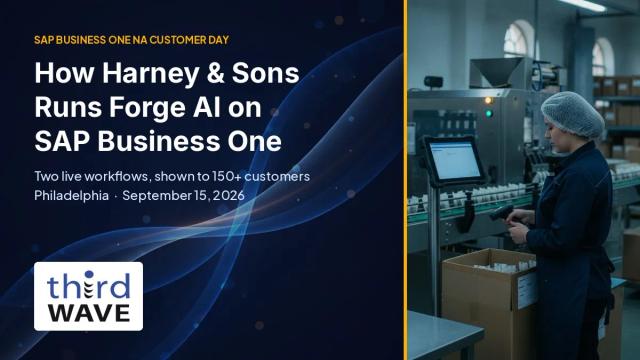
Harney & Sons Fine Teas closed SAP Business One Customer Day with Third Wave, showing 150+ customers two Forge workflows in production. We walk through shop floor data capture, AI sales order processing, the safeguards behind both, and Forge in the web client.
 Industry News
Regulators wrote 363 warning letters through late July without a single new rule taking effect. We cover the allergen-label recall surge, a natural color supply shortfall no purchase order will fix, input costs running ahead of shelf prices, and where plant money is going.
 Industry News
Canadian whey is now banned at the border, input prices hit their highest reading in months, and shoppers are walking away from brand-name price hikes. Here is what a month of rising costs and a falling price ceiling means for mid-sized food makers.