


You want your team spending the week on customers, quality, and growth. Most weeks go somewhere else: matching invoices, chasing late parts, answering stock questions, and settling whose number is right before a meeting starts.
AI agent use cases are specific, repeatable jobs an agent runs on your own systems and data. Forge AI, the AI agent platform Third Wave built for SAP Business One, runs ten today, from three-way invoice matching and late parts expediting to warranty review and relationship mapping. Most go live in 30 to 60 days. We put all ten into a new applications guide, and this post walks through each one: the problem, what Forge AI does about the problem, and the result your team sees. Two of the ten run in production today, at Current Tools and Airgoods. The other eight show the build on sample companies, so you see the shape before you pick one.
The pattern behind all ten is the same. Your systems each hold part of the truth, and your people carry the rest between them by hand. You should not have to hire another analyst to make your own numbers agree.
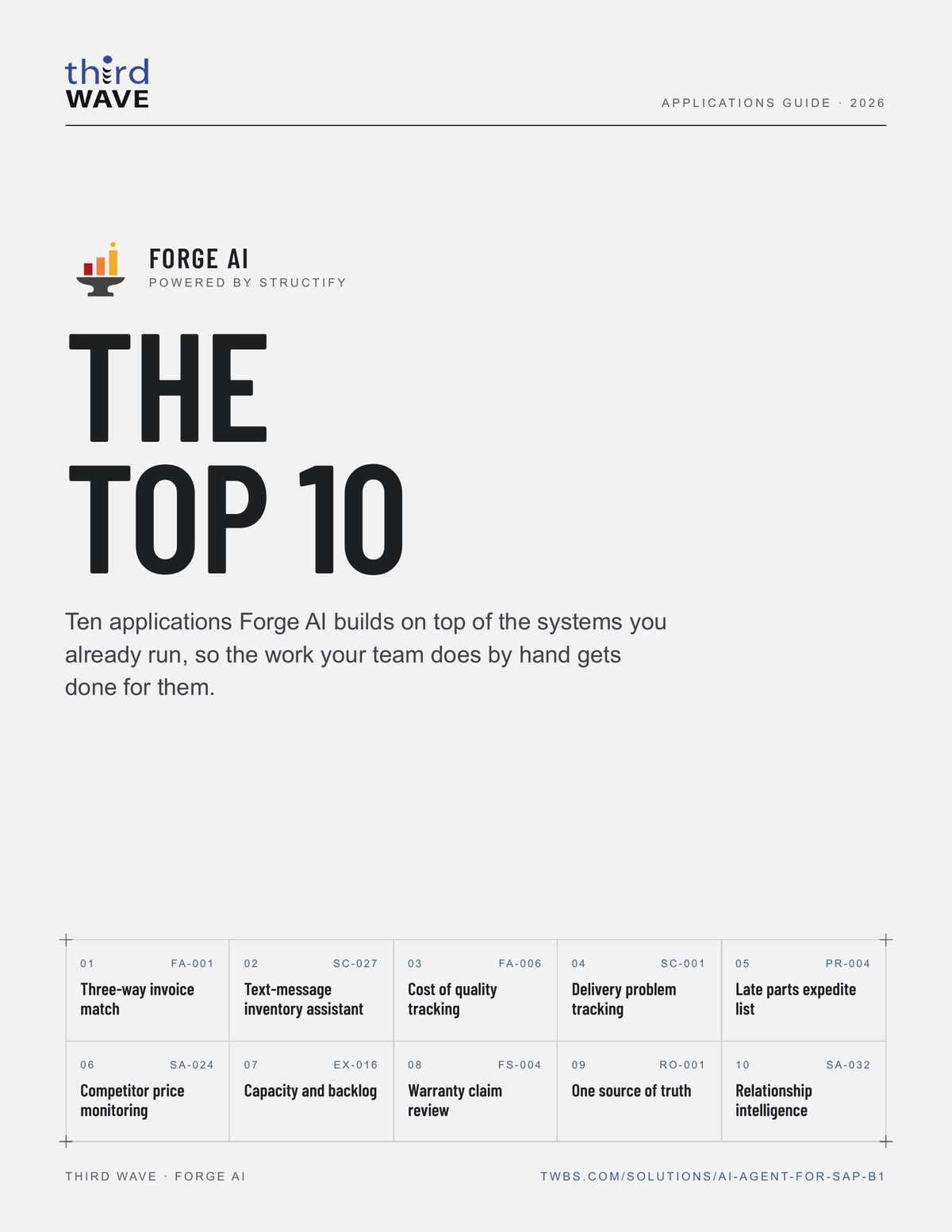
→ Download the Forge AI Top 10 Applications Guide (PDF)
Why an AI Agent, Not Another Off-the-Shelf Tool
Off-the-shelf tools stop at one step. Invoice capture reads the invoice. A supplier portal shows one supplier. A CRM knows what reps type in. Forge AI reads every system involved in the job, reasons across them under your rules, and takes the next step, from posting a clean invoice to drafting a supplier expedite.
We understand running a growing business on systems bought at different times for different jobs. Forge writes and runs code against the systems you already have instead of copying your data somewhere new. Each application runs on your systems, your data, and your brand, with narrow permissions per workflow and every action logged. For the wider shift from reporting to action, see Agentic AI in ERP: From System of Record to System of Action.
The ten applications below come from 500+ SAP Business One implementations with 98.7% client retention. The problems they solve show up across every industry. Harney & Sons Fine Teas took Forge from one production pilot to 15 people across four teams on SAP Business One, with nothing posting to SAP until a person approves.
1. Supplier Invoice Three-Way Match (FA-001)
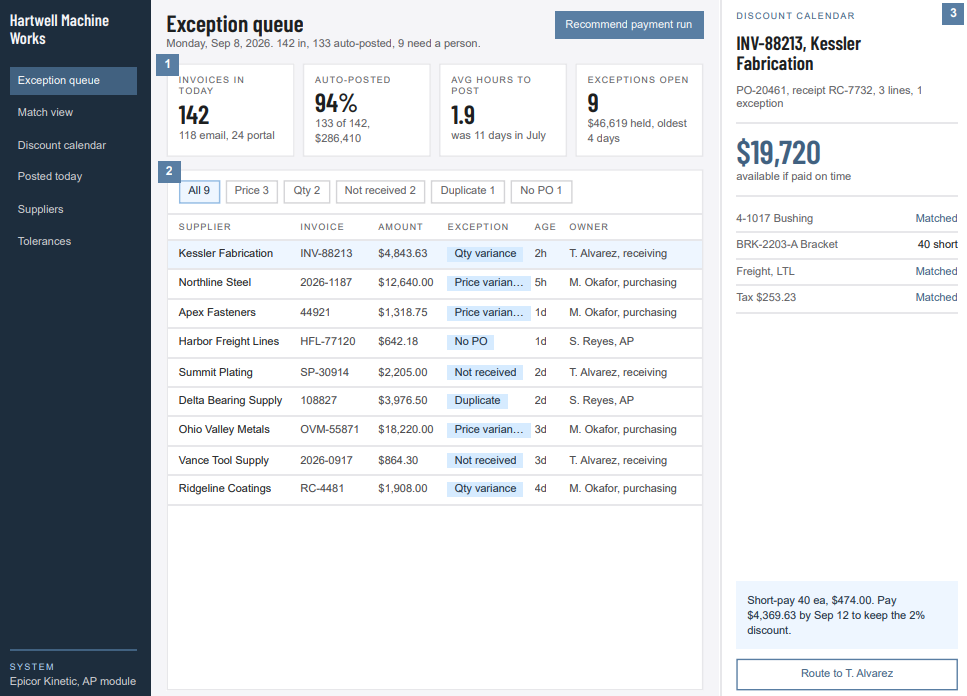
The Forge AI three-way match checks every supplier invoice against the purchase order and the receiving record in your ERP. Invoices inside your price and quantity tolerances post with no one touching them. Price, quantity, not-received, and duplicate exceptions go to the right person with the evidence attached.
The first build was for precision machining and job shops, where a hundred or more invoices arrive each day by email, supplier portal, and scanned paper. Matching by hand means opening the invoice, finding the PO, digging out the packing slip, and comparing line by line. Posting falls behind, and early-payment discounts expire in the inbox.
Invoice-capture software reads the invoice and stops. Forge also reads the purchase order and receiving records, applies your tolerances, posts into your accounting module, and recommends when to pay so the discount holds. Accounts payable spends the day on the few invoices with a real problem. Time to live is about 60 days.
2. Text-Message Inventory and Supplier Assistant (SC-027)
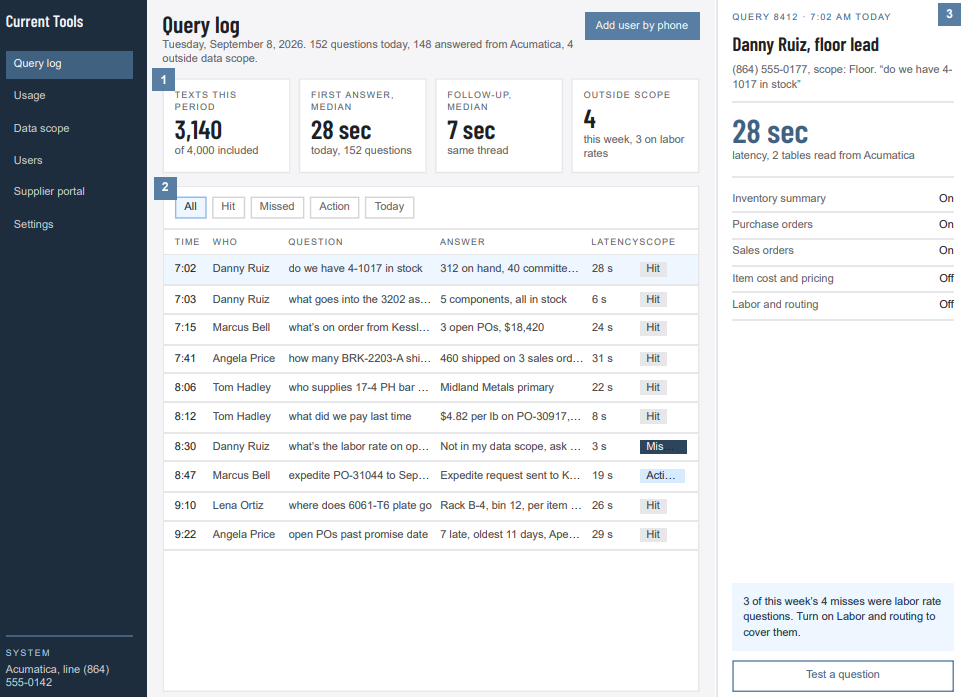
The Forge AI text-message assistant lets anyone on the floor text a plain-English question to one phone number and get the answer from the ERP in seconds. No login, no app, no training. Forge reads live inventory, purchase orders, and supplier data, limited to what each person is cleared to see.
Most people in a plant have no ERP login, and the ones who do would rather not walk to a terminal. So questions about stock, open orders, and supplier deliveries land on purchasing, who stop their own work to look them up, a hundred times a day. Forge maps shop slang to real part numbers and answers from live records.
Current Tools runs this application in production on the shop floor. The median time to a first answer is 28 seconds, and the first users were live 14 days after the team arrived onsite. Every question and answer is logged, and questions outside a person’s access, such as labor rates, are refused and flagged. Adding a user means adding a phone number. Time to live is about 30 days.
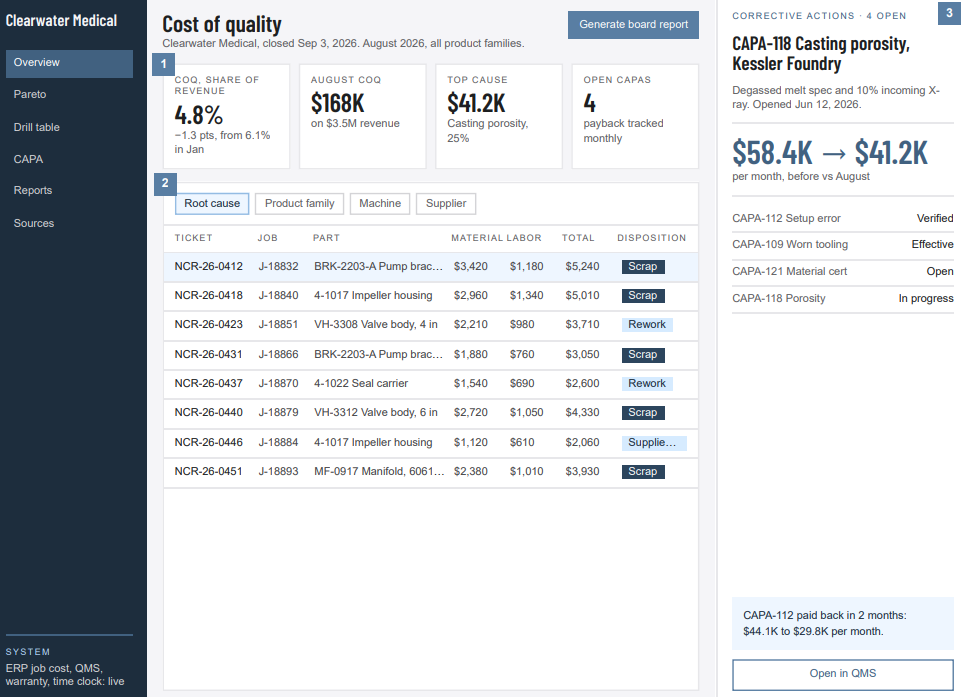
3. Cost of Quality Tracking (FA-006)
The Forge AI cost of quality application adds up what poor quality costs the business, including scrap, rework, returns, warranty, and inspection, and puts the total on the profit and loss statement. Every dollar lands in one of four buckets: prevention, inspection, failures caught inside, and failures caught by the customer.
The first build was for a medical device manufacturer. Those costs sat in job costing, the quality system, corrective-action records, and the time clock. Finance never saw one number, so quality improvements never got credit and the worst offenders never got fixed. Quality software tracks defects. Accounting software tracks dollars. Neither connects the two.
Forge joins job cost, corrective actions, warranty, and labor data into one model tied to your chart of accounts. A ranked chart shows the few product families and failure types driving most of the cost, and a board-ready report builds when the month closes. Every corrective action shows the payback in dollars. Time to live is about 45 days.
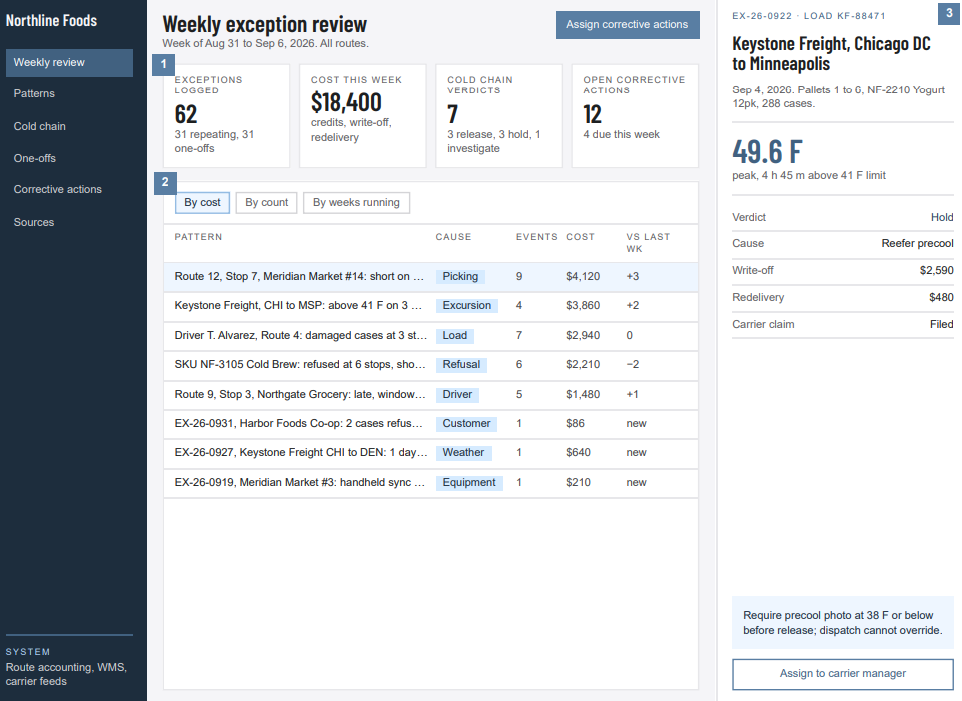
4. Delivery Problem Tracking and Prevention (SC-001)
The Forge AI delivery problem application collects every short, damaged, warm, or refused delivery in one place, finds the ones repeating week after week, and assigns each pattern a fix with an owner. Temperature data from each load becomes a release, hold, or investigate recommendation.
The first build was for food and beverage distribution, where delivery problems get logged in five places: route accounting, driver handhelds, carrier feeds, temperature loggers, and a claims inbox. Each problem gets handled as a one-off credit. Nobody sees the same stop, driver, or dock causing the same loss every week.
Forge groups problems by route, stop, driver, carrier, and product, creates corrective actions, and tracks whether the problem returns. Route software logs problems and claims software processes credits. Forge connects both to temperature and carrier data. Shorts and unauthorized returns fall, and credits shrink because causes get fixed instead of refunded. Time to live is about 60 days.
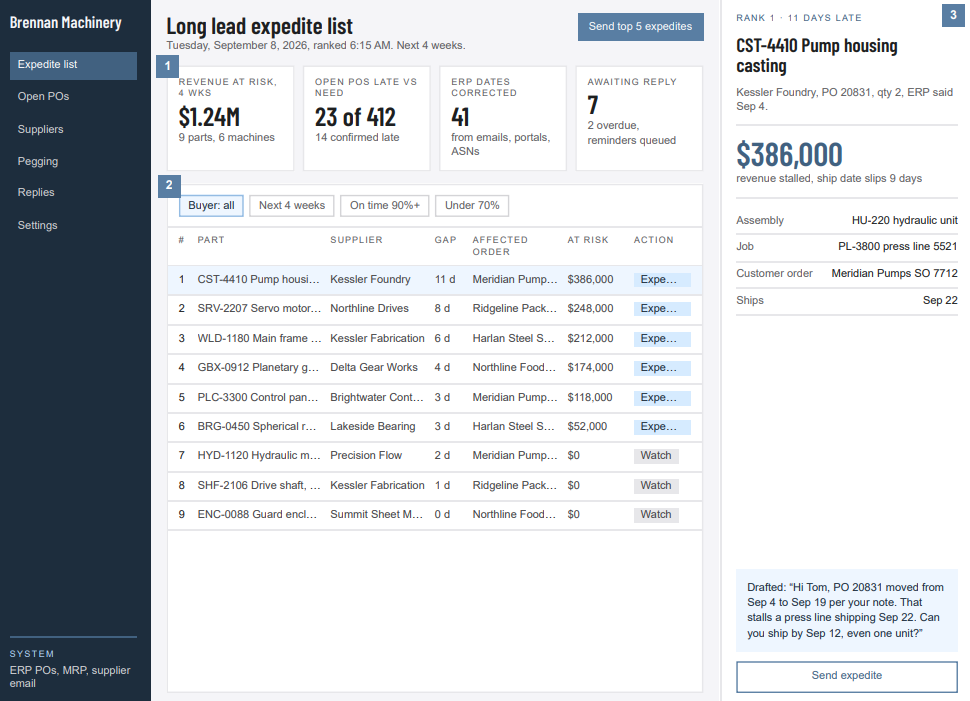
5. Late Parts Expedite List (PR-004)
The Forge AI late parts expedite list ranks every late or at-risk purchase order by the revenue the part holds up. Forge corrects promised dates from supplier emails, portals, and ship notices, links each part to the machines and customer orders depending on the part, and drafts the expedite email.
The first build was for an industrial equipment and machinery OEM with hundreds of open purchase orders. ERP dates drift because supplier updates arrive by email. Buyers chase whoever called last, while a single late casting quietly stalls several machines.
Supplier portals show one supplier’s orders. Forge reads every supplier’s confirmations, ties each part to customer orders through your planning data, then drafts and tracks the expedite. Buyers spend the morning on the few parts with real revenue behind them, and machines ship on the date sales promised. Time to live is about 45 days.
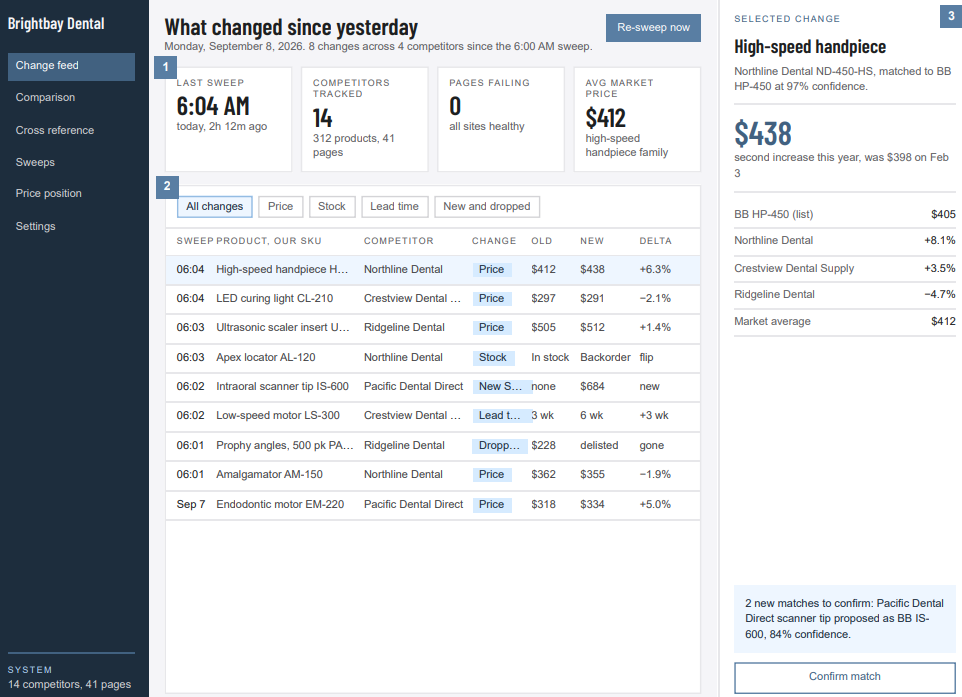
6. Competitor Price and Product Monitoring (SA-024)
The Forge AI competitor monitoring application sweeps competitor catalogs and distributor listings every morning and shows what changed overnight: price, stock, lead time, and new or dropped products. Forge matches each competitor listing to your own part numbers and puts market price position next to every quote.
The first build was for a dental device manufacturer selling through dealers and online distributors. Knowing where competitors priced each product meant someone checking dozens of websites by hand. The job took weeks, and the result was out of date on arrival.
Price-scraping tools hand you a spreadsheet of raw prices. Forge flags only meaningful moves, such as a price change over your threshold or a competitor stock-out, and feeds the answer to the people setting prices. Your sales team sees competitive moves before the first quote of the day goes out. Time to live is about 45 days.
7. Capacity and Backlog Dashboard (EX-016)
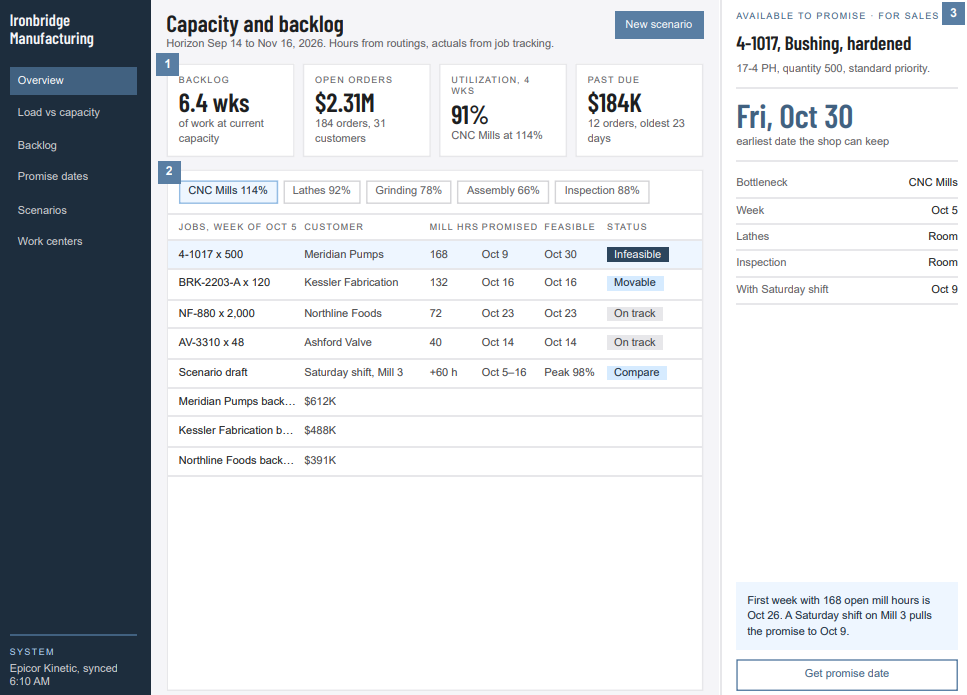
The Forge AI capacity and backlog dashboard shows how many weeks of work are booked, which machines and departments are overloaded, and the earliest delivery date the shop will meet. Forge reads open orders and routings from the ERP and loads booked hours against real capacity, week by week.
The first build was for precision machining and metalworking. Sales promised dates from memory. Scheduling knew the mills were overbooked, but only in a spreadsheet. The gap turned into late orders and expediting, the problem our manufacturing customers raise most often.
ERP capacity reports are static and hard to read. Forge refreshes the view every morning, flags overloaded work centres and late orders, and lets planners test overtime, outsourcing, or a new order before anyone commits a date. Sales gets promise dates the floor will keep. Time to live is about 45 days.
8. Warranty Claim Review (FS-004)
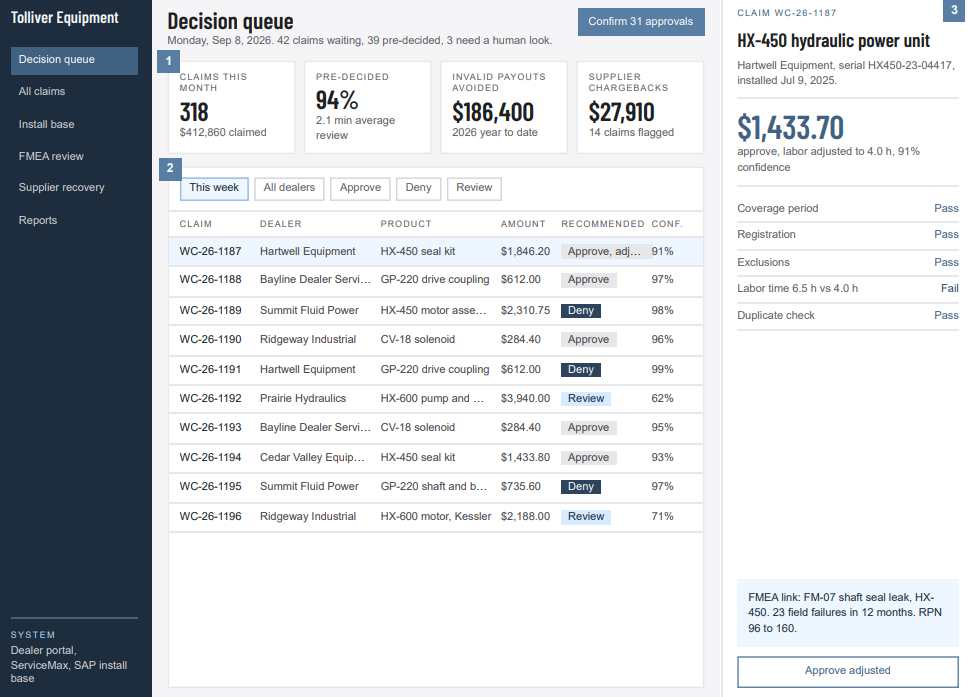
The Forge AI warranty claim application checks every dealer claim against the machine’s serial history, install date, coverage terms, and prior repairs, then recommends approve, deny, or investigate with the reason. Supplier-caused failures get flagged for chargeback, and failure patterns go back to engineering.
The first build was for industrial equipment and machinery. Dealers submit a photo and a few lines of text. Reviewers approve most claims by default, because checking serial history, coverage, and prior repairs by hand takes too long. Invalid payouts add up, and engineering never sees the pattern.
Warranty modules route claims. Forge checks each claim against your installed equipment and coverage terms, then turns the pattern into action: chargebacks to suppliers and proposed updates to engineering’s risk analysis. The result is fewer invalid payouts, more money recovered from suppliers, and real failure data in front of engineering. Time to live is about 45 days.
9. One Source of Truth for Sales and Operations Data (RO-001)
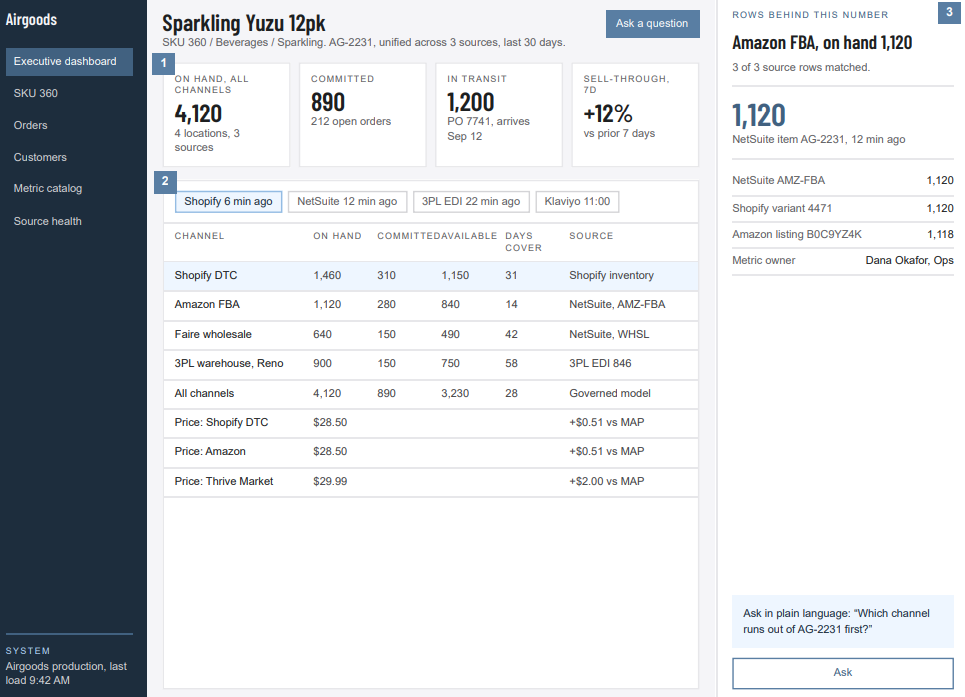
The Forge AI one source of truth application brings storefront, accounting, and warehouse data into one shared model, with one product key, one order history, and one set of metric definitions. Dashboards and plain-English questions run on the same model, so every team works from the same numbers.
Airgoods, a food and beverage wholesale marketplace, runs this application in production across sales, finance, and operations. Orders lived in Shopify, financials in a separate finance system, and inventory in the outside warehouse partner’s feed. Each system used different product codes and gave a different total, so meetings started with an argument about whose number was right. Forge connected the sources, unified the product codes, and defined each metric once, so revenue means one thing everywhere. A data warehouse vendor sells storage. Forge builds the links, keys, and definitions on top. Harney & Sons took the same approach on SAP Business One, matching 100,000+ records into one shared layer across production, procurement, and sales. Time to live is about 60 days.
10. Relationship Intelligence (SA-032)
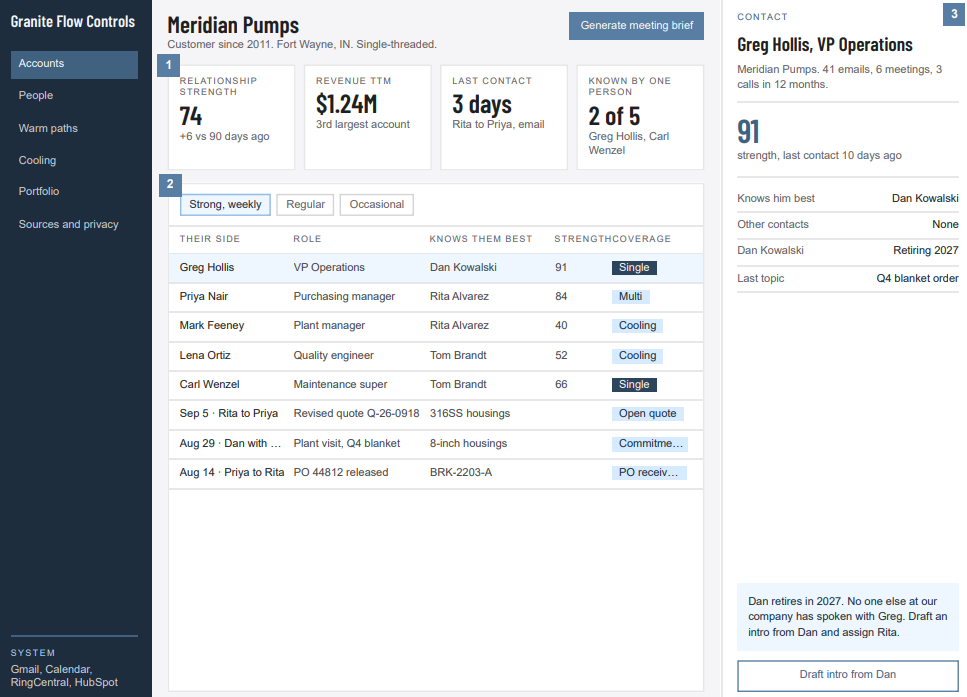
The Forge AI relationship intelligence application maps who at your company knows whom at each customer, using email, calendar, and call history. Forge scores each relationship for strength and recency, flags accounts depending on one person, and syncs the map to your CRM with a brief before every meeting.
Major accounts often rest on one salesperson. When the salesperson leaves, the relationship leaves too. Nobody else knows who the buyer’s boss is or when anyone last spoke to them, and the account goes quiet before anyone notices.
CRMs know only what reps type in. Forge reads real activity, with privacy controls, and turns the record into a relationship map inside HubSpot or Salesforce. Every key account gains more than one relationship, and turnover stops costing you customers. Time to live is about 45 days.
→ Download the Forge AI Top 10 Applications Guide (PDF)
How to Choose Your First Forge Application
Choose your first Forge application by cost, not novelty. Pick the job eating the most hours or leaking the most money each month, note the reference code from the list above, and bring the code to a short discovery call. Third Wave maps the build to your systems, your data, and your team.
- Choose an application. Note the reference code closest to your problem.
- Talk to Third Wave. A short discovery call maps the build to your systems.
- Go live. Forge builds and runs the application, with your people using the tool from day one.
Connecting Forge to SAP Business One takes about 30 minutes, and the standard plan starts with a 14-day free trial. The applications above are builds on top of the connection, which is why each carries a 30 to 60 day time to live. Before you start, our ERP data readiness check shows whether your records are ready for an agent to work on.
Waiting has a price. Every month on the manual version means another stack of invoices posted late, another lost discount, another late casting nobody ranked, and another claim approved by default. None of these shows up as one line on a report. Together they cost you margin and slow your growth.
What Changes When Your First Application Goes Live
With the first Forge application live, your team stops doing the work between systems by hand. Accounts payable works the exceptions. Buyers chase the parts with revenue behind them. Sales quotes dates the floor will meet. Leadership opens one set of numbers and spends the meeting on decisions, not reconciliation. See why Forge AI and what it does across your business.
The second application goes faster, because the data and controls from the first carry over. Harney & Sons followed this path: one pilot on the production floor, then procurement, product, and commercial teams on the same foundation. Your people get the week back for customers, quality, and growth, the work you hired them to do.
Pick One. We Will Build It.
Every application in this list runs on your systems, your data, and your brand, and most go live in 30 to 60 days. Book a conversation with our team and bring the reference code for the problem costing you most. We will map the build to your stack on the first call.
Not ready to talk? See Forge, the AI agent for SAP Business One and start the 14-day free trial, or take the ERP assessment to see where your data stands today.
Frequently Asked Questions
What are the most common AI agent use cases in manufacturing?
The most common AI agent use cases in manufacturing sit between systems: three-way invoice matching, late parts expediting, capacity and backlog planning, cost of quality tracking, and warranty claim review. Each one replaces manual lookups across the ERP, email, and spreadsheets with an agent working under your rules.
How long does a Forge AI application take to go live?
Most Forge AI applications go live in 30 to 60 days. The text-message inventory assistant takes about 30 days, and the invoice match and one source of truth builds take about 60. Connecting Forge to SAP Business One takes about 30 minutes, and each application builds on the connection.
Do I need SAP Business One to use Forge?
No. Forge works with the major ERPs and reaches the rest of your stack through 200+ pre-built connectors. Third Wave built Forge on deep SAP Business One experience, and Forge connects to SAP Business One live through the Service Layer.
Can Forge post transactions without a person approving them?
You decide. Each workflow runs on narrow permissions, and teams such as Harney & Sons require a person to approve before anything posts to SAP Business One. Every action is logged with who submitted the entry, when, and which document resulted.
How much does Forge cost?
Forge starts with a 14-day free trial with no credit card required, then $500 per month for three user seats. Custom connectors and implementation work are billed time and materials by Third Wave, and each application build is scoped on a short discovery call.
Which Forge application should we start with?
Start with the job costing you the most hours or money each month. For most manufacturers the answer is invoice matching, late parts, or capacity. Note the reference code, such as FA-001, and bring the code to a discovery call with Third Wave.