

Third-Highest Monthly Orders on Record, 360,000 Welders Short: This Month in Industrial Equipment and Machinery
- Third Wave StaffInsights from the Third Wave team
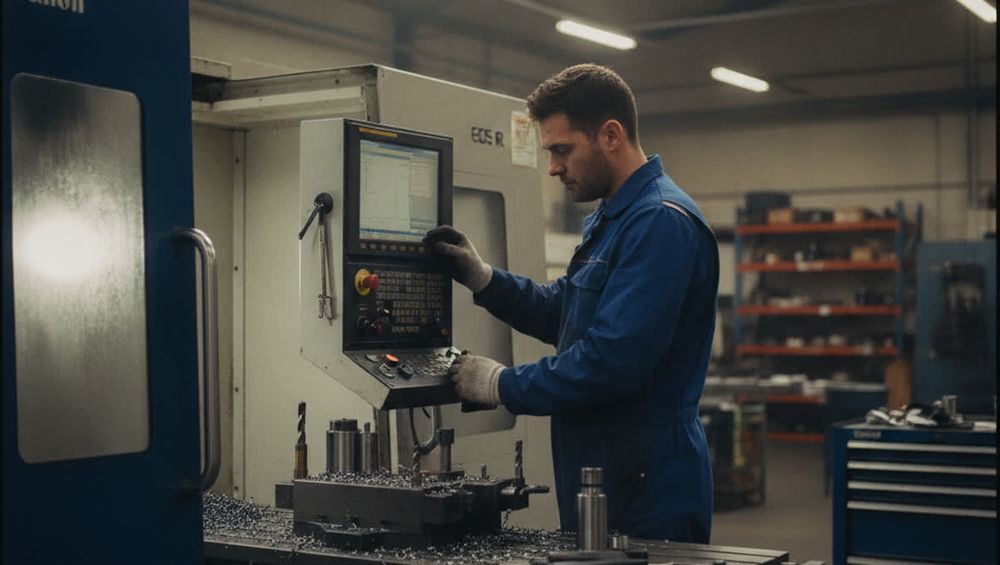
The Association for Manufacturing Technology reported $732.9 million in metalworking machinery orders for August, the third-highest monthly total since the USMTO data series began in 1998. Orders rose 21% from July and 36.3% from a year earlier, extending a year-to-date run of roughly $4.76 billion through eight months. 2026 is on pace for a full-year record near $7 billion. The ISM manufacturing index reached 55.5% in October, its tenth consecutive month of expansion, with machinery listed among the twelve industries reporting growth. The production subindex came in at 59.0%, the highest reading since November 2021.
Two-thirds of ISM respondents described general business conditions in negative terms. This is not a contradiction in the data. Demand is real and orders are running. The floor is running into something else.
For manufacturers and job shops in the $10M to $200M range, the November 2026 story is not whether the order book is full. The order book is full. The question is whether the operational infrastructure to handle it is.
In this issue
- August metalworking orders: $732.9M, 3rd-highest monthly total since 1998 (+21% m/m, +36.3% y/y)
- October ISM PMI: 55.5%, 10th consecutive expansion, production index at a 5-year high of 59.0%
- Core capital goods, September: machinery orders +1.2% m/m, +16.1% y/y
- Section 179 and bonus depreciation: $2.56M deduction limit, 100% write-off, December 31 deadline
- Cobots for smaller manufacturers: Q1 units +55.6%, revenue +78.2%
- 360,000 welders projected short by 2027, 2.1 million manufacturing roles unfilled
- Electrical equipment: 52 to 144+ weeks for switchgear and transformers
- $2.091 trillion in announced private US manufacturing investment commitments
The Demand Signal
September machinery orders rose another 1.2% month over month and 16.1% year over year in the Commerce Department’s core capital goods report, arriving on the heels of August’s $732.9 million USMTO reading. Take both months together and the signal is consistent: manufacturing technology demand is not cyclically soft, it is running at levels not seen in a generation. IMTS 2026, held in Chicago in September with roughly 90,000 visitors and 2,000 exhibitors, contributed to September’s order activity as conversations from the show floor converted into purchase orders, the typical seasonal pattern following the trade show. The demand environment heading into Q4 looks constructive.
The October ISM headline of 55.5% confirmed the expansion continues, and the composition of the report matters as much as the number itself. The production subindex at 59.0% is the signal worth watching for equipment demand: factories running above capacity buy machines. The backlog of orders index at 54.6% is down 1.8 points from September but still firmly expansionary. Customer inventories remain too low per ISM’s index, a reading historically associated with future production orders. New orders also expanded, up 0.2 points to 55.5%.
The 66% negative general sentiment in the same ISM survey reflects prices, not volume. Input costs remain elevated: the prices paid index was 75.2% in October, down from 77.9% in September but still indicating broad materials cost pressure. For equipment makers sourcing steel and aluminum, the year began with tariff adjustments absorbed across the supply chain. Machinery orders rose 1.2% in September’s durable goods report with primary metals up 0.5% and fabricated metals up 0.4%. Orders are strong. Margin management remains the active work.
The Year-End Window
Two tax provisions make the final two months of 2026 unusually consequential for any equipment purchase progressing since IMTS. Section 179 allows businesses to deduct up to $2,560,000 in qualifying equipment in the tax year it goes into service, a limit roughly doubled from prior years by legislation signed July 4, 2025. Separately, 100% bonus depreciation is now permanent for qualifying property. Together, the two provisions allow most small and mid-sized businesses to write off the full cost of a machine purchase in the year of acquisition, even when the equipment is financed. Most shops purchasing less than $4.09 million of equipment in 2026 access the full deduction without hitting the phase-out.
The operative phrase is “placed in service.” An order placed in November does not qualify if the machine is not operational by December 31. For shorter-lead equipment, this window is real. For long-lead custom machinery or electrical infrastructure, it is not. Buyers evaluating a cobot or a machining center since IMTS have roughly eight weeks to close, receive, and commission.
Cobots specifically are worth noting here. North American companies ordered 1,637 collaborative robots in the first quarter of 2026, up 55.6% in units and 78.2% in revenue from the year before. The low-cost cobot market sits at $3 to $4 billion in 2026 and projects to $13 to $17 billion by 2034. Robot-as-a-service models from companies such as Formic and Rapid Robotics are structured to remove the capital barrier for smaller factories, offering per-hour pricing and no upfront cost. For a shop closing a labor gap before year-end without committing a machine-tool budget, a RaaS deployment places in service within weeks and addresses the capacity argument without the balance-sheet hit.
The Binding Constraints
IndustrialSage is tracking approximately $2.091 trillion in announced private-sector US manufacturing and industrial investment commitments as of late October, spanning 275 companies across 44 states. The Reshoring Initiative’s 2025 data showed 247,000 US manufacturing jobs created or attributed to reshoring and foreign direct investment, with the share of contract manufacturers quoting reshoring projects roughly doubling from 16% to 33%. Policy uncertainty remains the leading concern, cited by 57% of respondents.
The electrical infrastructure gap is a different problem with similar timing implications. Lead times for 15 kV switchgear now run approximately 52 weeks. Large step-up transformers are quoting 128 to 144 weeks, and in some cases longer. Power transformer prices have risen roughly 77% since 2019, and medium-voltage switchgear runs two to four times pre-pandemic lead times. Bloomberg reported earlier this year close to half of planned US data center builds for 2026 were delayed or cancelled with equipment shortages listed as the primary cause. The same bottleneck applies at a smaller scale to any manufacturing facility adding significant electrical load for new automation.
These two constraints interact directly. Cobots and automated machining cells reduce reliance on hard-to-hire welders and machinists. Installing them requires certified electricians and adequate facility power. The electrician shortage is itself acute, and the electrical equipment to support expanded capacity is running 52 to 144 weeks out. A shop deciding in November to automate one production cell will not be fully operational until 2028 if the facility requires new power infrastructure. The wise move is ordering the electrical infrastructure now, before the year-end machinery decision, not after.
Where the Investment Is Going
IndustrialSage is tracking approximately $2.091 trillion in announced private-sector US manufacturing and industrial investment commitments as of late October, spanning 275 companies across 44 states. The Reshoring Initiative’s 2025 data showed 247,000 US manufacturing jobs created or attributed to reshoring and foreign direct investment, with the share of contract manufacturers quoting reshoring projects roughly doubling from 16% to 33%. Policy uncertainty remains the leading concern, cited by 57% of respondents.
For contract machine shops and job shops, this investment wave is order flow, not capital at risk. Companies committing to US domestic manufacturing need precision machined components, fabricated assemblies, and specialty parts. This reshoring surge has been one driver behind the extended strength in job shop ordering activity documented through 2026. Converting announced investment into actual production depends on workforce and electrical infrastructure, the same two items discussed above. The business opportunity is real. The bottleneck is in the floor, not the inbox.
The Bottom Line
The demand signal for industrial equipment and machinery is as strong as it has been in a generation. The gap between what the order book says and what the floor delivers is not closing on its own. The constraint in late 2026 is not capital appetite or demand. The constraint is skilled trades and long-lead infrastructure.
For a mid-market manufacturer evaluating a capital purchase before December 31, the tax math is favorable and the year-end window is real. The question worth answering first: does the facility have the electrical capacity to run what you are buying, and do you have the people to operate it? Getting the operations side right before committing to the capital side is the difference between a productive Q1 and an idle machine.
In case you missed it
- Reformulation Pressure Went Mainstream: This Month in Food and Beverage (November 2026)
- Demand Is Holding, Margins Are Not: This Month in Wholesale Distribution (October 2026)
- Input Costs at 77.9 and Rising: This Month in Manufacturing (October 2026)
- Orders Up 53%, Shipments Up 1%: This Month in High-Tech and Electronics (October 2026)
Ready to understand what your operations need?
If your shop is running strong order volume and hitting capacity constraints, the operational issues show up in your data first. Disconnected systems make them harder to see and slower to fix. Third Wave helps mid-market manufacturers and job shops build the operational foundation to handle growth cleanly. Start with the assessment: it takes ten minutes and shows where the biggest gaps are.